
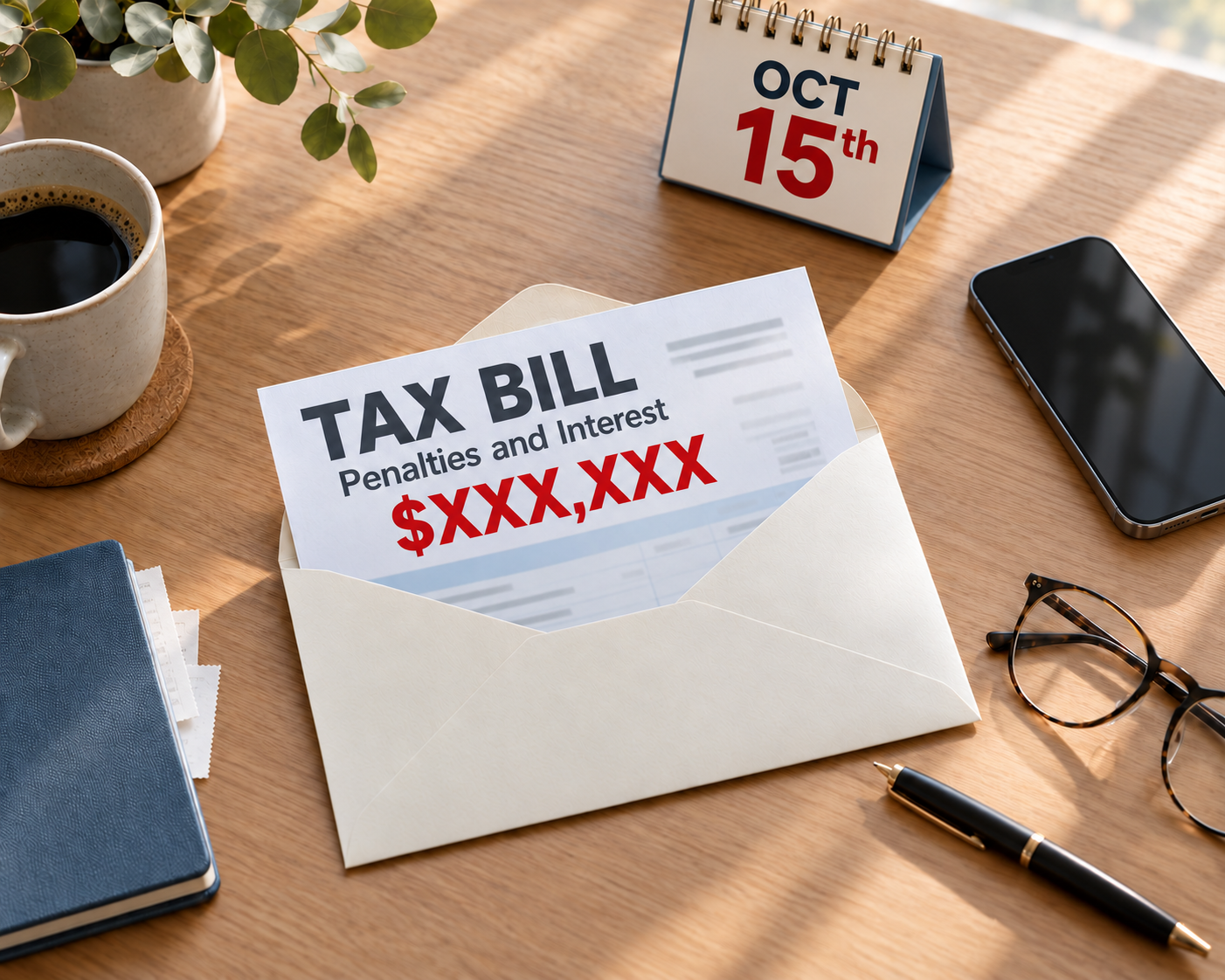
Every year, around the October extension deadline, we see the same thing.
A business owner finally files, and the bill is bigger than expected. Sometimes penalties come with it. Sometimes the cash isn’t there, and the only option left is a payment plan with the IRS.
Usually the business did fine. Often it did better than the owner realized. They just didn’t feel that success, because the cash didn’t stay in the bank. It went back into the business, paid down debt, or got spent. So when it came time to file, they had no idea what to expect.
I call it trick-or-treating with your tax bill: walking up to the door with no idea whether you’ll get a trick or a treat. It’s about the worst way to do taxes. It’s also completely avoidable, and it’s within your control.
Know What’s Coming
The problem usually isn’t that the business didn’t make money. It’s that nobody knew how much it made until it was too late to do anything about it.
Profit and cash aren’t the same thing, and the tax follows profit, not your bank balance. If you own a business or rental properties, that profit usually has nothing withheld. The tax builds up all year whether you’re watching or not. Your return doesn’t create the bill. It just shows it to you.
Knowing your number early is half the battle. Your stress goes down, because you know what’s coming. And knowing gives you two options.
Plan to pay it. Set the cash aside so the bill is just a bill, not an emergency.
Plan to reduce or defer it. This is the option I’d push most business owners toward. If you’re growing your business, deferring tax is almost always worth trying to do. Every dollar you don’t send to the IRS this year is a dollar still working in your business.
A few common examples:
-
- Equipment and vehicles. Under current law, many business assets can be deducted largely or entirely in the year they’re placed in service. “Placed in service” matters: the asset generally has to be in use by December 31, not just ordered.
-
- Retirement plans. A retirement plan can shift a meaningful amount of income out of this year. Some plans must be set up before December 31 to count for that year; others can be set up later. Which one fits depends on your business and your employees.
-
- Timing of income and expenses. Depending on how your business keeps its books, when you bill and when you pay can move income between years.
One caution: the purchase still has to make sense on its own. Buying a $100,000 truck you don’t need to save $35,000 in tax still leaves you $65,000 poorer. Deferral works best when you’re investing in growth you were going to pursue anyway, and timing it so the tax benefit lands when you need it.
Either way, you’re deciding instead of reacting. If you don’t know your number, you can’t change it.
How you get there depends on your setup:
-
- If you work with an accountant or bookkeeper, your books are probably already being kept. The question is whether anyone is reading them. A few times a year, and at least once by midyear, set aside an hour with your CPA to go over what the profit is so far and what it means for your tax return.
-
- If you have rentals or a side business, give each one its own bank account. When one account holds one activity, year-end becomes easy.
-
- If you do your own accounting, let AI do the first pass. Many business owners now use tools like ChatGPT to organize transactions for a small sole proprietorship or a few rentals. Give it the transaction detail from a clean, separate account, let it categorize, and let it ask about what it can’t figure out. Just remove account numbers and personal details before uploading anything, and remember that AI organizes; it doesn’t make tax decisions. (Rental owners: it will happily call a new roof a “repair.” It isn’t.)
How Penalties Actually Work
Pay as you earn
The IRS and most states are pay-as-you-earn. If you’re earning money today, they want their share today. That’s why quarterly estimated payments exist. Federal estimates are due in April, June, September, and January.
To generally avoid the federal underpayment penalty, your withholding and estimates need to cover one of these:
-
- 100% of last year’s tax (110% if last year’s adjusted gross income was over $150,000), or
-
- 90% of this year’s tax.
Paying based on last year protects you from the penalty, even if you earn more this year. It doesn’t protect you from the surprise. If your business grew, the rest of the bill is still coming. States have their own rules. California, for example, front-loads its estimates and doesn’t let taxpayers with income of $1 million or more rely on last year’s number.
Filing late vs. paying late
Here’s what catches people every year:
An extension gives you more time to FILE. It does NOT give you more time to PAY.
Whatever you still owe is due in April. After that, two separate federal penalties can apply:
-
- Late payment: 0.5% of the unpaid tax per month, up to 25%.
-
- Late filing: 5% of the unpaid tax per month, also up to 25%.
That’s why you should file on time (or on extension) even if you can’t pay. Late filing costs ten times as much per month as late payment. And on top of either penalty, interest runs on the unpaid balance, compounded daily, at a rate the IRS resets every quarter.
A hypothetical example: You owe $60,000 in April, file on extension, and pay in October. At recent rates, the late-payment penalty and interest together come to roughly $3,800, and that’s before any underpayment penalty or state charges.
The 90% rule
There’s a useful target here. If you file on extension and, by the April deadline, at least 90% of your total tax has been paid (withholding, estimates, and your extension payment combined), the IRS generally won’t charge the late-payment penalty, as long as you pay the rest when you file. Interest still applies to the remainder, but the penalty generally doesn’t.
So if you’re extending, estimate the bill and pay at least 90% by April. The return can wait. The money can’t.
Can penalties be waived?
Sometimes, but you can’t rely on it.
At the federal level, first-time penalty relief is available only if your prior three years are clean: no significant penalties, returns filed, taxes paid or on a payment plan. Use it once, and you generally can’t use it again for a while. It also doesn’t cover the estimated-tax underpayment penalty, and it doesn’t remove the interest on the tax itself.
California’s version is stricter: once in a lifetime, and only for individuals, not businesses. Some states, like New York, are hard to qualify with at all.
Treat abatement as a one-time pass, not a plan.
What about payment plans?
If you can’t pay, file anyway, and then set up a payment plan. For a return filed on time, the federal late-payment penalty generally drops to 0.25% per month while the plan is in place. That helps, but the penalty doesn’t go away, and interest keeps running on the full unpaid balance the entire time. A payment plan gives you and the IRS agreed terms. It doesn’t make the problem cheap.
When to Look
-
- Midyear (June or July): the best time. You have time to change the number and time to prepare the cash.
-
- Fall (October or November): still worth doing. Your options to change the number are narrowing, but you can still make year-end purchases, adjust your final estimate, and plan your cash.
-
- After year-end: the number is mostly set. You can still plan the cash, but by then you’re preparing to pay, not deciding what to pay.
The goal isn’t to never owe tax. It’s to know what’s in the bag before you open it.
If you’d like a second set of eyes on your numbers before the year closes, that’s a conversation we have with business owners all the time.